Agriculture is at the heart of life in The Gambia. It provides livelihoods for more than 70% of the population and plays a vital role in food production, employment, and rural development. Yet the sector is facing growing challenges. Rising temperatures, unpredictable rainfall, soil degradation, and increasingly frequent floods and droughts are making it harder for farmers to maintain productivity and secure their incomes.
In this context, Climate-Smart Agriculture (CSA) is emerging as a key solution to help farming communities adapt to a changing climate while improving food security and economic opportunities.
Rather than a single farming technique, Climate-Smart Agriculture is an approach that promotes more sustainable and resilient agricultural practices. It combines methods such as efficient water management, soil conservation, crop diversification, agroforestry, climate-resilient crops, and the use of innovative technologies to help farmers increase productivity while protecting natural resources.
For The Gambia, the need for this transition is becoming increasingly urgent. Agriculture remains largely dependent on rainfall, while less than 3% of farmland is irrigated. At the same time, climate change is disrupting traditional farming cycles, reducing yields, and increasing pressure on already fragile ecosystems. These challenges affect not only agricultural production but also food security, rural livelihoods, and long-term economic development.
By adopting more resilient farming practices and integrating innovation into agricultural production, farmers can improve yields, make better use of natural resources, and reduce their vulnerability to climate shocks. At the same time, the transition towards greener agricultural systems creates new opportunities for entrepreneurship, employment, and local economic growth.
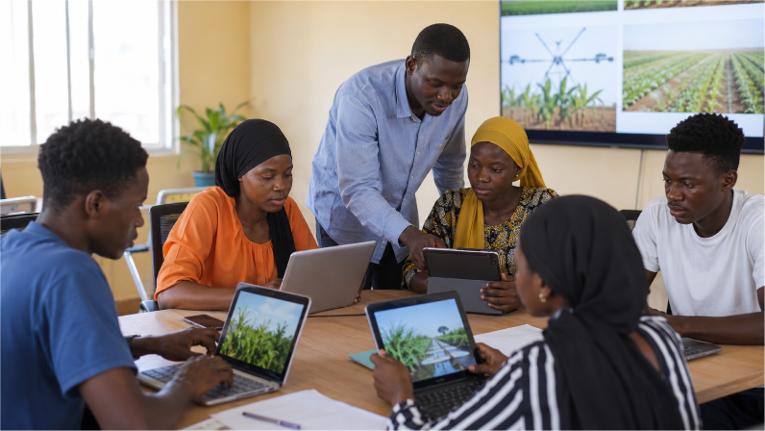
However, achieving this transformation requires more than technology alone. It also depends on people having the right knowledge and skills. This is why education and training play such an important role in supporting sustainable agriculture.
The AGREEN GAMBIA project has been designed to help address this challenge by strengthening the capacity of the Technical and Vocational Education and Training (TVET) system to support the transition towards Climate-Smart Agriculture. By investing in skills, innovation, and sustainable farming practices, AGREEN GAMBIA aims to help build a more resilient agricultural sector capable of responding to climate challenges while creating new opportunities for communities across the country.